



Les publications universitaires listées ici sont en majorité consultables gratuitement sur Internet. Les indications pour les trouver figurent alors à la fin de la référence bibliographique : simple mention [Texte intégral] si la publication est consultable en suivant le lien présent dans la référence ; sinon, et si l'un des auteurs a déposé l'une des versions de la publication sur un autre site, second lien, avec nom du site concerné (principalement ResearchGate, réseau social académique). Pour quelques uns des sites, l'accès au texte intégral nécessite la création préalable d'un compte. Seuls les cas où le compte est gratuit sont indiqués ici.
Bratman, G. N., Hamilton, J. P., Hahn, K. S., Daily, G. C., & Gross, J. J. (2015). Nature experience reduces rumination and subgenual prefrontal cortex activation. Proceedings of the National Academy of Sciences, 112(28), 8567‑8572. https://doi.org/10.1073/pnas.1510459112 [Texte intégral]
Berto, R. (2014). The role of nature in coping with psycho-physiological stress: a literature review on restorativeness. Behavioral Sciences, 4(4), 394‑409. https://doi.org/10.3390/bs4040394 [Texte intégral]
Cordoza, M., Ulrich, R. S., Manulik, B. J., Gardiner, S. K., Fitzpatrick, P. S., Hazen, T. M., Mirka, A., & Perkins, R. S. (2018). Impact of nurses taking daily work breaks in a hospital garden on burnout. American Journal of Critical Care, 27(6), 508-512. https://doi.org/10.4037/ajcc2018131 [Texte intégral sur ResearchGate]
Gonzalez, M. T., Hartig, T., Patil, G. G., Martinsen, E. W., & Kirkevold, M. (2010). Therapeutic horticulture in clinical depression: a prospective study of active components. Journal of Advanced Nursing, 66(9), 2002‑2013. https://doi.org/10.1111/j.1365-2648.2010.05383.x [Texte intégral sur ResearGate]
Grahn, P., Tenngart Ivarsson, C., Stigsdotter, U., & Bengtsson, I.-L. (2010). Using affordances as a health-promoting tool in a therapeutic garden. Dans Innovatives approaches to researching landscape and health (p. 116-154). Routledge. https://doi.org/10.4324/9780203853252 [Texte intégral sur ResearchGate]
Hartig, T., Mitchell, R., De Vries, S., & Frumkin, H. (2014). Nature and Health. Annual Review of Public Health, 35(1), 207-228. https://doi.org/10.1146/annurev-publhealth-032013-182443 [Texte intégral]
Joubert, A., Jankowski-Cherrier, B., Rossi, A., Teyssier, L., Suraud, V., Presle, E., Pommier, R., Massoubre, C., & Verot, E. (2024). Impact of horticultural therapy on patients admitted to psychiatric wards, a randomised, controlled and open trial. Scientific Reports, 14(1). https://doi.org/10.1038/s41598-024-65168-0 [Texte intégral]
Kamioka, H., Tsutani, K., Yamada, M., Park, H., Okuizumi, H., Honda, T., Okada, S., Park, S., Kitayuguchi, J., Abe, T., Handa, S., & Mutoh, Y. (2014). Effectiveness of horticultural therapy: A systematic review of randomized controlled trials. Complementary Therapies in Medicine, 22(5), 930-943. https://doi.org/10.1016/j.ctim.2014.08.009
Kaplan, S. (1995). The restorative benefits of nature: Toward an integrative framework. Journal of Environmental Psychology, 15(3), 169‑182. https://doi.org/10.1016/0272-4944(95)90001-2 [Texte intégral sur Social Science Library]
Li, Q., Morimoto, K., Kobayashi, M., Inagaki, H., Katsumata, M., Hirata, Y., Hirata, K., Suzuki, H., Li, Y., Wakayama, Y., Kawada, T., Park, B., Ohira, T., Matsui, N., Kagawa, T., Miyazaki, Y., & Krensky, A. (2008). Visiting a forest, but not a city, increases human natural killer activity and expression of anti-cancer proteins. International Journal of Immunopathology and Pharmacology, 21(1), 117‑127. https://doi.org/10.1177/039463200802100113 [Texte intégral]
Pálsdóttir, A., Persson, D., Persson, B., & Grahn, P. (2014). The Journey of Recovery and Empowerment Embraced by Nature — Clients’ Perspectives on Nature-Based Rehabilitation in Relation to the Role of the Natural Environment. International Journal of Environmental Research and Public Health, 11(7), 7094-7115. https://doi.org/10.3390/ijerph110707094 [Texte intégral]
Park, B. J., Tsunetsugu, Y., Kasetani, T., Kagawa, T., & Miyazaki, Y. (2009). The physiological effects of Shinrin-yoku (taking in the forest atmosphere or forest bathing) : evidence from field experiments in 24 forests across Japan. Environmental Health and Preventive Medicine, 15(1), 18-26. https://doi.org/10.1007/s12199-009-0086-9 [Texte intégral]
Pommier, R., Pringuey, D., Pringuey-Criou, F., Boulon, Y., Boyer, S., & Massoubre, C. (2017). Approche qualitative de l’éprouvé au Jardin de Soins. Une étude exploratoire en Psychiatrie de l’Adulte. Annales Médico-psychologiques, revue Psychiatrique, 176(2), 150 156. https://doi.org/10.1016/j.amp.2017.06.006 [Texte intégral sur le blog Le bonheur est dans le jardin, format PDF]
Pringuey, D., & Pringuey-Criou, F. (2014). Le jardin de soins, recours thérapeutique : aspects psychopathologiques et phénoménologiques, implications thérapeutiques. L’Encéphale, 41(3), 197‑201. https://doi.org/10.1016/j.encep.2014.10.025
Pringuey-Criou, F. (2015). Introduction au concept de jardins de soins en psychiatrie. L’Encéphale, 41(5), 454‑459. https://doi.org/10.1016/j.encep.2015.04.004
Rivasseau-Jonveaux, T., Pop, A., Fescharek, R., Chuzeville, S. B., Jacob, C., Demarche, L., Soulon, L., & Malerba, G. (2012). Les jardins thérapeutiques : recommandations et critères de conception. Gériatrie et Psychologie Neuropsychiatrie du Viellissement, 10(3), 245 253. https://doi.org/10.1684/pnv.2012.0360 [Texte intégral]
Stigsdotter, U. A., & Grahn, P. (2002). What makes a garden a healing garden? Journal of Therapeutic Horticulture, 13, 60–69. http://www.jstor.org/stable/44025048 [Texte intégral]
Ulrich, R. S. (1984). View through a window may influence recovery from surgery. Science, 224(4647), 420-421. https://doi.org/10.1126/science.6143402 [Texte intégral sur ResearchGate]
Ulrich, R. S., Cordoza, M., Gardiner, S. K., Manulik, B. J., Fitzpatrick, P. S., Hazen, T. M., & Perkins, R. S. (2019). ICU patient family stress recovery during breaks in a hospital garden and indoor environments. HERD Health Environments Research & Design Journal, 13(2), 83 102. https://doi.org/10.1177/1937586719867157 [Texte intégral sur ResearchGate]
Wichrowski, M., Whiteson, J., Haas, F., Mola, A., & Rey, M. J. (2005). Effects of horticultural therapy on mood and heart rate in patients participating in an inpatient cardiopulmonary rehabilitation program. Journal of Cardiopulmonary Rehabilitation, 25(5), 270 274. https://doi.org/10.1097/00008483-200509000-00008 [Texte intégral]
La Fédération a réalisé en 2024 avec le soutien du fonds de dotation Green Link une infographie sur les preuves scientifiques des bienfaits pour la santé de la relation à la nature :
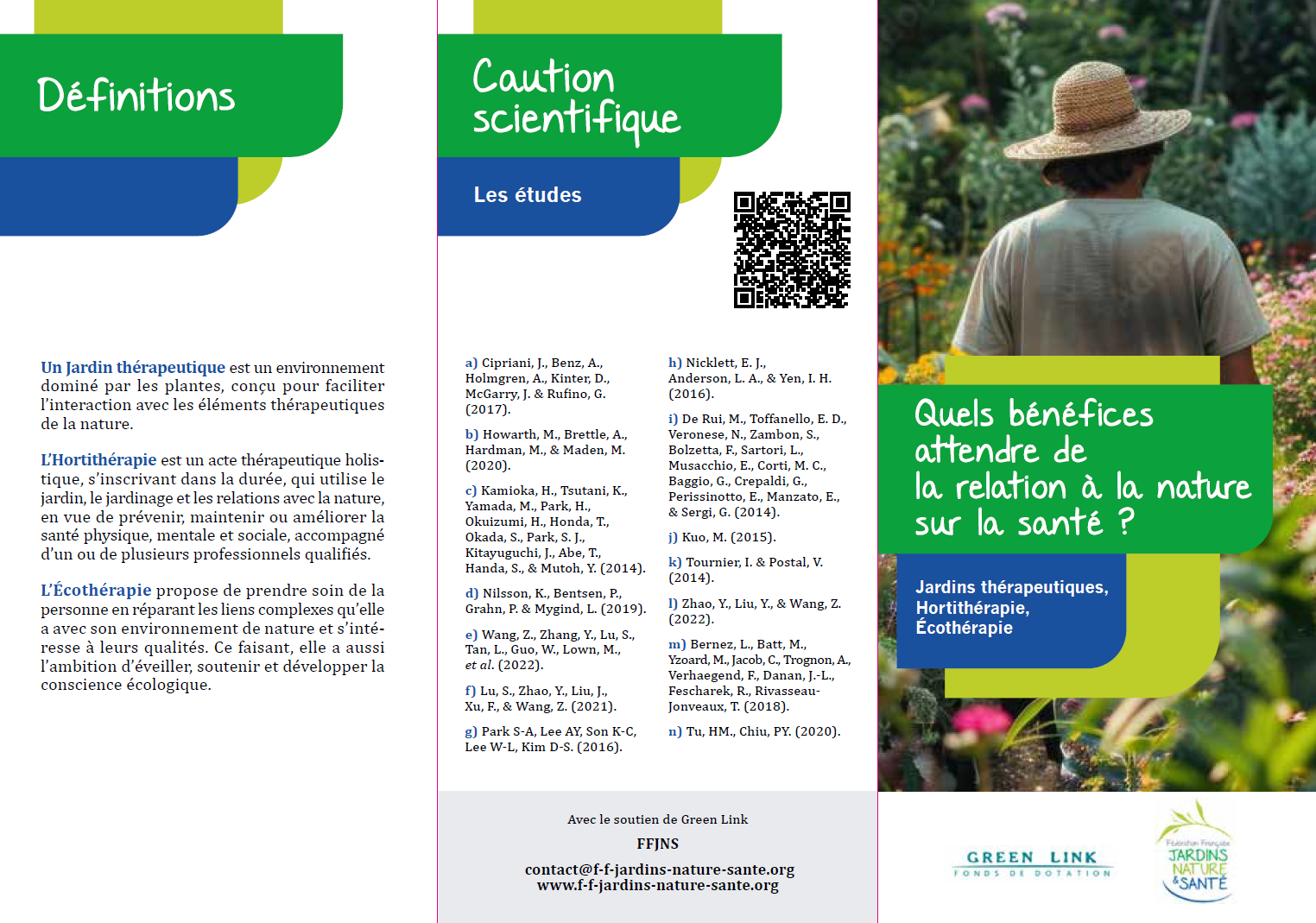
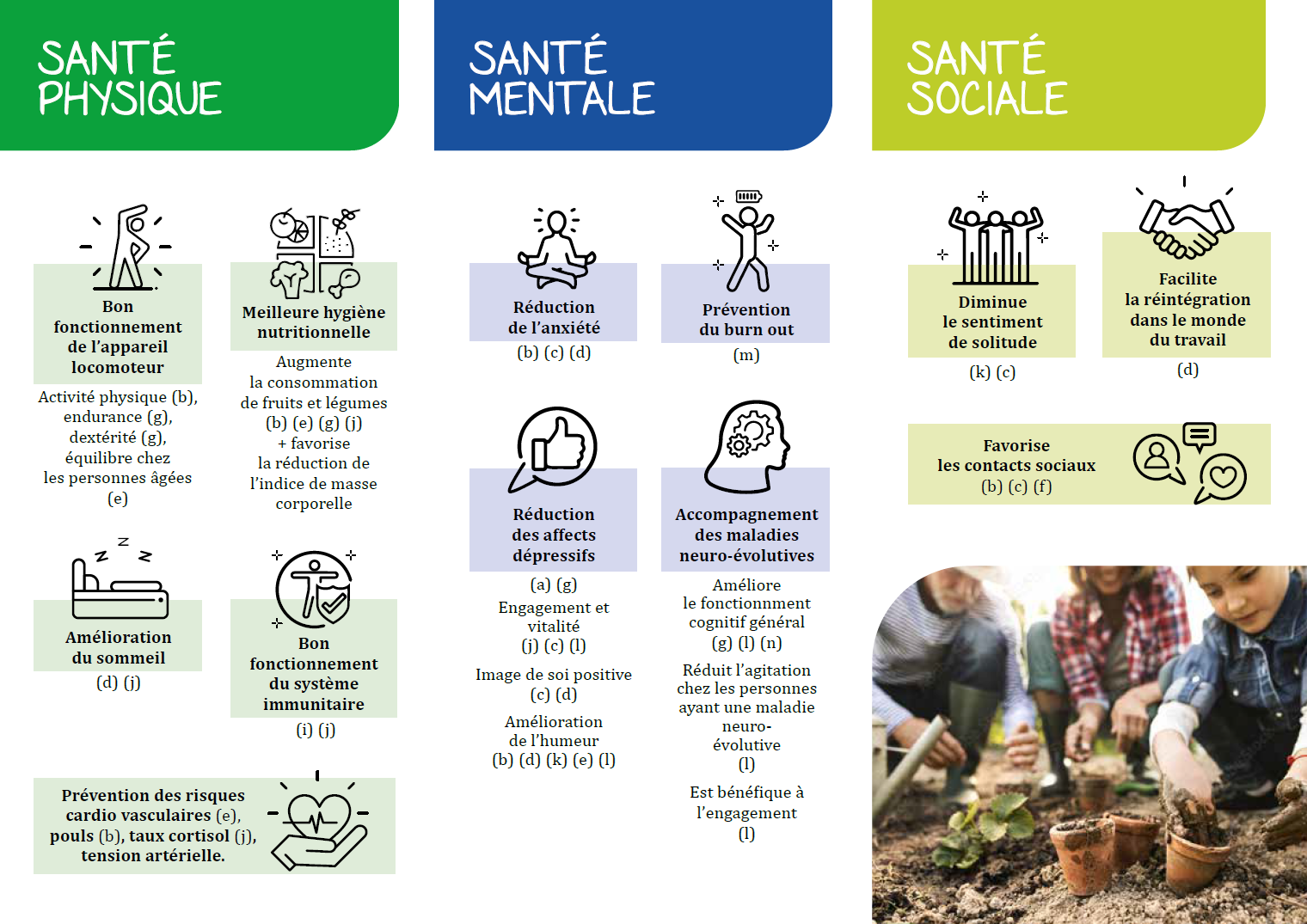
Cliquer sur les images pour les agrandir, ou télécharger l’infographie au format PDF (250 ko) : infographie-benefices-relation-nature.pdf
La liste ci-dessous présente les références bibliographiques des articles scientifiques cités dans l’infographie. Ils sont en majorité consultables gratuitement sur Internet. Les indications pour les trouver figurent alors à la fin de la référence bibliographique :
– simple mention [Texte intégral] si l'article est consultable en suivant le lien présent dans la référence ;
– sinon, et si l'un des auteurs a déposé l'une des versions de l'article sur un autre site, second lien, avec nom du site concerné (principalement ResearchGate, réseau social académique). Pour quelques uns des sites, l'accès au texte intégral nécessite la création préalable d'un compte. Seuls les cas où le compte est gratuit sont indiqués ici.
D'autres articles scientifiques sont présentés à la page Publications universitaires.
(a) Cipriani, J., Benz, A., Holmgren, A., Kinter, D., McGarry, J., & Rufino, G. (2017). A systematic review of the effects of horticultural therapy on persons with mental health conditions. Occupational Therapy in Mental Health, 33(1), 47‑69. https://doi.org/10.1080/0164212x.2016.1231602
(b) Howarth, M., Brettle, A., Hardman, M., & Maden, M. (2020). What is the evidence for the impact of gardens and gardening on health and well-being : a scoping review and evidence-based logic model to guide healthcare strategy decision making on the use of gardening approaches as a social prescription. BMJ Open, 10(7), e036923.https://doi.org/10.1136/bmjopen-2020-036923 [Texte intégral]
(c) Kamioka, H., Tsutani, K., Yamada, M., Park, H., Okuizumi, H., Honda, T., Okada, S., Park, S., Kitayuguchi, J., Abe, T., Handa, S., & Mutoh, Y. (2014). Effectiveness of horticultural therapy: A systematic review of randomized controlled trials. Complementary Therapies in Médicine , 22(5), 930‑943. https://doi.org/10.1016/j.ctim.2014.08.009 [Texte intégral sur Academia]
(d) Nilsson, K., Bentsen, P., Grahn, P., & Mygind, L. (2019). De quelles preuves scientifiques disposons-nous concernant les effets des forêts et des arbres sur la santé et le bien-être humains ? Santé Publique, S1(HS1), 219-240. https://doi.org/10.3917/spub.190.0219 [Texte intégral]
(e) Wang, Z., Zhang, Y., Lu, S., Tan, L., Guo, W., Lown, M., Hu, X., & Liu, J. (2022). Horticultural therapy for general health in the older adults: A systematic review and meta-analysis. PLOS One, 17(2), e0263598. https://doi.org/10.1371/journal.pone.0263598 [Texte intégral]
(f) Lu, S., Zhao, Y., Liu, J., Xu, F., & Wang, Z. (2021). Effectiveness of horticultural therapy in people with schizophrenia: A systematic review and meta-analysis. International Journal of Environmental Research and Public Health, 18(3), 964. https://doi.org/10.3390/ijerph18030964 [Texte intégral]
(g) Park, S., Lee, A., Son, K., Lee, W., & Kim, D. (2016). Gardening intervention for physical and psychological health benefits in elderly women at community centers. HortTechnology, 26(4), 474‑483. https://doi.org/10.21273/horttech.26.4.474 [Texte intégral]
(h) Nicklett, E. J., Anderson, L. A., & Yen, I. H. (2014). Gardening activities and physical health among older adults. Journal of Applied Gerontology, 35(6), 678‑690. https://doi.org/10.1177/0733464814563608 [Pré-publication sur PMC PubMed Central]
(i) De Rui, M., Toffanello, E. D., Veronese, N., Zambon, S., Bolzetta, F., Sartori, L., Musacchio, E., Corti, M. C., Baggio, G., Crepaldi, G., Perissinotto, E., Manzato, E., & Sergi, G. (2014). Vitamin D deficiency and leisure time activities in the elderly: Are all pastimes the same? PLOS One, 9(4), e94805. https://doi.org/10.1371/journal.pone.0094805 [Texte intégral]
(j) Kuo, M. (2015). How might contact with nature promote human health? Promising mechanisms and a possible central pathway. Frontiers in Psychology, 6. https://doi.org/10.3389/fpsyg.2015.01093 [Texte intégral]
(k) Tournier, I., & Postal, V. (2014). Proposition d’un modèle intégratif concernant les bénéfices psychologiques du jardinage chez les personnes âgées. Gériatrie et Psychologie Neuropsychiatrie du Vieillissement, 12(4), 424‑431.https://doi.org/10.1684/pnv.2014.0498 [Texte intégral]
(l) Zhao, Y., Liu, Y., & Wang, Z. (2020). Effectiveness of horticultural therapy in people with dementia: A quantitative systematic review. Journal of Clinical Nursing, 31(13‑14), 1983‑1997. https://doi.org/10.1111/jocn.15204
(m) Bernez, L., Batt, M., Yzoard, M., Jacob, C., Trognon, A., Verhaegen, F., Danan, J., Fescharek, R., & Jonveaux, T. R. (2018). Jardin thérapeutique, outil de prévention du burnout. Psychologie Française, 63(1), 73‑93. https://doi.org/10.1016/j.psfr.2017.02.001 [Texte intégral sur ResearchGate]
(n) Tu, H., & Chiu, P. (2020). Meta-analysis of controlled trials testing horticultural therapy for the improvement of cognitive function. Scientific Reports, 10(1). https://doi.org/10.1038/s41598-020-71621-7 [Texte intégral]
 Retrouvez les informations passées et actuelles de la Fédération Françaises Jardins Nature et Santé sur cette page.
Vous en saurez ainsi plus sur la vie de la Fédération : actions menées, manifestations et toute autre information en rapport avec les jardins de soins et l’hortithérapie, qui pourrait intéresser les membres de la Fédération et les visiteurs du site.
|
|
|
|
|
|
|
|
|
|
|
|
|
|
|
|
|
|
|

9 octobre 2024 :
"L’hortithérapie peut trouver sa place comme pratique complémentaire de la médecine" Article : à lire sur agri-city.info
Extrait :
““La faible représentation de l’hortithérapie en Suisse romande m’a amené à développer un réseau très étendu vers l’extérieur. Je représente par exemple la section francophone de Société suisse d’hortithérapie, aujourd’hui principalement développée dans la partie germanophone et m’investit également dans un réseau d’échange européen auquel participe la fédération française des jardins nature et santé (FFJNS)*““
Juillet 2022 :
Horticultural Therapy Institute : Article : Follow a Year-Long Expedition to Discover Hortithérapie Experiences from Across the Globe
Extrait :
““Le Jardin, c’est la santé – The Garden is Health”. The intention of the design was to create a tangible rendering of Roger Ulrich’s 1984 study, View Through a Window May Influence Recovery from Surgery. When the visitor enters the exhibit, they find themselves in a stark and sterile hospital room. A hospital chair (like what you would sit in to receive intravenous drugs) and equipment are the only objects in the room. The chair is facing an open window with a view of a lush green garden space.”
Juin 2022 :Juin 2022 :
La croix : Article : Verts et or. La chronique de Laurence Cossé
Extrait :
“Sous les beaux arbres des Tuileries, des exposants d’un autre genre rappelaient qu’un jardin n’est pas seulement un luxe de citadins redécouvrant la nature mais un précieux auxiliaire de santé. Les thérapeutes ont pris conscience il y a une soixantaine d’années qu’un jardin, sa contemplation, la possibilité de s’y tenir et surtout le jardinage, peut aider à vivre ceux qui souffrent de maladies, de handicaps ou tout simplement des effets du grand âge. Quiconque a rechigné devant une cour à désherber reconnaît, le dernier pissenlit arraché, que le pensum lui a fait du bien. Jardiner apaise, diminue les troubles du comportement, contient l’angoisse ou les états dépressifs, permet de créer des liens humains et de remédier au repli sur soi. C’est tout simplement un plaisir.”
Septembre 2020 :
ASH (actualités sociales hebdomadaire) : Article : Jardins. “INSERTION, SOIN et DIGNITE”
Un dossier très riche qui met en avant les nombreux bienfaits du jardin et raconte plusieurs expériences dans divers établissements (insertion sociale et professionnelle, centre éducatif fermé (CEF), auprès de personnes âgées dans le souci du maintien à domicile,…). Où l’on cite Sonia Trinquier de l’association Mosaïque des jardins et des hommes, membre de la FFJNS.
Juin 2020 :
CUEJ INFO : Article : L ‘appel du potager
Les étudiants en journalisme du CUEJ de Strasbourg se penchent sur le confinement et les « loisirs de l’après » et pensent à faire une place au jardinage. Cela donne cet article de Justine Maurel qui reflète bien la connexion intensifiée ou la découverte du jardin pendant la période exceptionnelle que beaucoup ont vécues.
Mars 2020 :
AGRI CITY : Article : Soigner au jardin : rencontre avec France Criou-Pringuey, médecin et paysagiste
Pour tout savoir, ou presque sur France Criou-Pringey, son évolution, ses motivations, sa vision.
Janvier 2020 :
RCF Isère : Article : L’hortithérapie, soigner en jardinant.
Bravo à Roger Mahieu et Heidi Rotteneder, deux membres actifs de la FFJNS, qui parlent très bien d’hortithérapie dans l’émission “La Maison Commune” !
France Inter : Emission : Carnets de campagne
Estelle Alquier, fondatrice des Jardins de l’Humanité et membre fondatrice de la FFJNS, présente son projet unique en France,
Décembre 2019 :
La Gazette Sociale-Santé : la nature humanise le soin
“Le contact avec la nature peut constituer un élément majeur d’un programme thérapeutique ou éducatif dans lequel les personnes soignées ou accompagnées prennent soin du vivant”.
C’est ce qu’écrit Solange de Fréminville en introduction de son article intitulé “La nature humanise le soin” paru dans La Gazette Social-Santé en décembre. Elle cite plusieurs membres de la FFJNS qui témoignent sur leurs expériences (Romain Pommier pour le Jardin des Mélisses du CHU de Saint-Etienne, Sonia Trinquier de l’association Mosaïque, Stéphane Lanel de la Maison des Aulnes et Isabelle Boucq, la présidente de la FFJNS”.
Octobre 2019 :
Ouest France : Article : Et si le jardin aidait à nous soigner ?
En maison de retraite comme à l’hôpital, la nature gagne du terrain. Explications du docteur en psychologie Jérôme Pellissier.
Septembre 2019 :
Le Dr Good : Article : Des jardins qui soignent
Depuis quelques années, des jardins thérapeutiques fleurissent… En quoi ca consiste? Pour qui ? …
Les 4 saisons au jardin bio : Brève de septembre : Une fédération pour l’hortithérapie
“… Faire reconnaitre l’utilité de la médiation par le jardin et la nature… “
Mars 2019 :
Le Dauphiné Libéré : Article du 21 mars Naissance de la FFJNS
La fédération rassemble des professionnels de différents domaines, allant de la santé à l’écologie et au paysage, à l’éducation, à l’action sociale…
Le Lien Horticole : Article Lien Horticole mars
Sensibilisation aux bienfaits des jardins thérapeutiques
Février 2019 :
Le blog de l’Horticultural Therapy Institute: https://htinstitute.org/community/blog/
Le HTI, un des principaux centres de formation à l’hortithérapie basé à Denver aux Etats-Unis, annonce la création de la Fédération Française Jardins, Nature et Santé.